

There is a moment in every woman’s transformation journey that no one prepares you for — the moment when you have done enough of the work to know you cannot go back, but you haven’t yet fully arrived at who you are becoming. You are no longer who you were, and you are not yet who you are meant to be. You are in the in-between.
This liminal space is uncomfortable. It is tender and disorienting and, at times, profoundly lonely. Your old patterns no longer fit, but your new ones don’t yet feel natural. The relationships, roles, and identities that once defined you begin to loosen — and the question of who you actually are, beneath all of that, rises to the surface with startling urgency.
This post is for the woman who is standing in that space right now. It is for every woman who has been doing the work — healing old wounds, learning to communicate differently, rebuilding her relationship with herself — and who is now navigating the tender, complicated territory between her old self and the woman she is becoming.
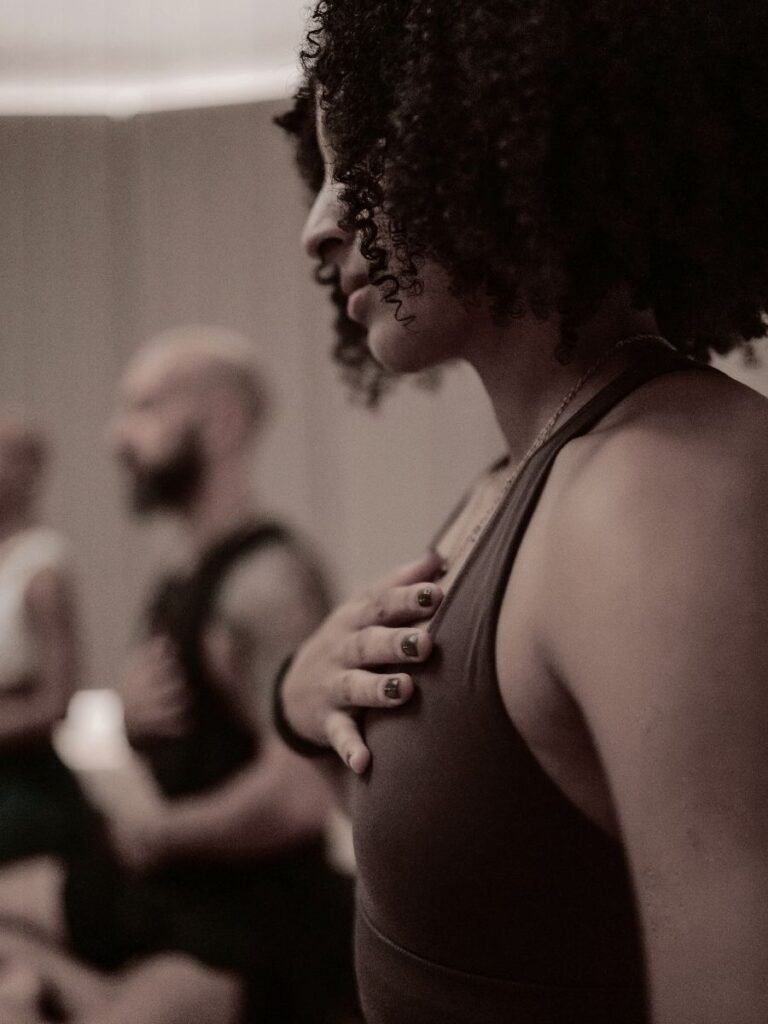
Keep reading to find out why my Radical Embodiment Method — Reflect, Release, Re-Envision, Re-Design — will support you in your transformation.
The Old Self Will Always Fight to Stay
Real transformation is not simply a decision. It is not a matter of choosing to be different and waking up changed. It is a living, breathing process — and it involves a very real tension between the version of you who is familiar, predictable, and known, and the version of you who is emerging, expansive, and still finding her footing.
Your old self is not the enemy. She was built for a reason — to protect you, to help you survive, to navigate a world that may not have always felt safe. She found ways to belong, even if those ways required her to make herself smaller than she truly was. She is not something to be discarded. She is something to be understood, honored, and ultimately, lovingly released.
“The old self will always fight to keep its identity. That’s not a sign of failure — it’s a sign that the transformation is real.”
The new version of you — the one who sets boundaries, speaks her truth, and chooses herself without apology — is not yet fully trusted. Not by the world around you, and often, not yet by yourself. And so the in-between feels unsteady. That unsteadiness is not a problem to be fixed. It is the terrain of becoming.
REM Process — Reflect: Be the Wise Seeker
→ Identify the beliefs and survival patterns your old self developed — and why they made sense at the time.
→ Reconnect with your core values through visualization: who is the woman underneath the conditioning?
→ Uncover which identities you have been clinging to and ask honestly whether they still serve you.

Worth Is Not Something You Earn by Overgiving
One of the most deeply embedded beliefs women carry into transformation is this: that their value is tied to what they do for others. The overgiving, the people-pleasing, the constant availability — these are not simply habits. They are a sophisticated, embodied belief system that says, “I am worthy of love only when I am useful.”
This is not true worth. It is a brilliant coping mechanism — one that likely kept you connected to people and environments where conditional love was the only kind on offer. But it comes at a devastating cost: you disappear. You give and give and give until there is nothing left to give, and then you wonder who you are when there is no one left to take care of.
The invitation of transformation is to locate your worth somewhere far more stable than the approval or gratitude of others. Your worth is not a variable. It is not something that goes up when you help and down when you say no. It is inherent, unconditional, and completely independent of what you produce for the people around you.
“We found our worth in being the person who overgave — and that was actually where we found our unworthiness.”
REM Process — Release: Be the Peaceful Warrior
→ Release the old belief that your value is determined by how much you give or sacrifice.
→ Tap into your body’s wisdom — notice where the pattern of overgiving lives physically, and breathe into releasing it.
→ Let go of the need for external validation as the measure of your worth.
Teetering between old you and new you? That’s a win in itself—self-awareness is an epic milestone. Here’s to not skipping any part of the journey to healing.
Boundaries Are Not Walls...They Are Bridges to Real Love
In the in-between, setting boundaries feels counterintuitive at best and terrifying at worst. If your entire identity has been built around being available, agreeable, and accommodating, then drawing a line — saying “this is what I need,” or “this is what I will no longer accept” — can feel like you are being selfish, harsh, or unkind.
But here is what is actually true: a boundary is not a rejection of another person. It is a declaration of your own value. It says, “I matter enough to protect my time, my energy, my emotional wellbeing.” And paradoxically, when you stop giving from a place of fear and obligation and begin giving from a place of genuine desire and wholeness, everything you offer becomes more real, more nourishing, and more sustainable.
The fear underneath most boundary-setting resistance is the fear of loss — the fear that if you stop being endlessly accommodating, the people you love will leave. And the truth is: some might. But what you will discover, on the other side of that fear, is that the relationships which remain are the ones built on something real. Not on your willingness to disappear, but on your willingness to show up fully.
REM Process — Re-Envision: Be the Master Innovator
→ Create a vision of yourself in relationships where your boundaries are honored and your presence is celebrated.
→ Reframe the fear of loss: what relationships become possible when you stop performing and start being real?
→ Awaken your authentic voice — the one that can say what it needs with compassion and without apology.

Guilt, Shame, and the Grief of Letting Go
As you step into your new identity, you will almost certainly encounter guilt. Guilt for changing. Guilt for no longer being who others expected you to be. Guilt for wanting more, for needing differently, for outgrowing the roles that once defined you. And underneath the guilt, often, is grief — the grief of releasing an identity that, however painful, was also deeply familiar.
This guilt is not evidence that you are doing something wrong. It is evidence that you care — about the people in your life, about the relationships you are navigating, about the impact your transformation has on those around you. But caring about others does not require you to sacrifice your own becoming.
What makes this process particularly complex is that identity is rarely just one thing. Your sense of self is layered — built from years of roles, relationships, expectations, and stories. When those layers begin to shift, it can feel as though the entire structure of your world is changing. Because it is. And that is not a catastrophe. That is the miracle of transformation, disguised as discomfort.
REM Process — Re-Design: Be the Confident Creator
→ Use creative strategies to consciously design your new identity — not from fear of the old, but from love of what’s emerging.
→ Find your tribe: women who are doing this work alongside you and who will hold space for your becoming.
→ Build accountability into your transformation so that when guilt arises, you have support to move through it rather than back.
Purchase Your Inner Strength Accelerator Pack for $27
Truth Is Not Just Facts, It Is Embodied Communication
One of the most profound shifts in transformation is learning to communicate differently — not just more honestly, but more wholly. Most of us were taught to communicate in facts: what happened, who said what, what the timeline was. But facts alone are often incomplete. They leave out the texture of your inner experience — the feelings, the values, the deeper truth of what something meant to you.
Heart-centered communication, the kind the Radical Embodiment Method teaches, invites you to speak from a fuller place. It includes your feelings alongside your observations. It carries your values and your sensitivities. It acknowledges your inner reality, not just external events. And it does all of this without weaponizing truth — without using honesty as a blunt instrument when a thoughtful, compassionate one would do far more good.
There is also something important to be said about manipulation — the unconscious kind that most of us have practiced for years. When you stay quiet to avoid conflict, you are attempting to manipulate the outcome. When you overgive hoping someone will stay, you are attempting to manipulate the outcome. The antidote is not harshness — it is honesty, offered with gentleness and rooted in genuine self-respect.
REM Process — Reflect: Be the Wise Seeker
→ Examine the places where you have been communicating in facts rather than truth — and what has been left unsaid.
→ Reconnect with what you actually feel and need, beneath the carefully managed version of yourself you present to others.
→ Discover where the manipulation patterns live and what fear is driving them.
Moving Forward: Feeling Your Way Into the New
Moving into your new self is not a linear process. There will be days when you feel fully arrived — grounded, clear, and deeply at home in who you are becoming. And there will be days when the old patterns pull hard, when the familiar ache of overgiving or silencing yourself feels easier than the uncomfortable work of staying true.
The practice is not perfection. The practice is awareness. It is learning to notice when you have slipped back, to name what you are feeling without making it your entire identity, and to choose — again and again — to move forward rather than stay stuck. “I am feeling anxious right now” is very different from “I am an anxious person.” The first is a weather report. The second is a life sentence.
Your body is one of your greatest guides in this process. When you feel constriction, heaviness, or that hollow sense of going through the motions — pay attention. When you feel expansion, aliveness, and a sense of moving toward something real — pay equal attention. The body knows the way, long before the mind has caught up.
“The new identity is asking you not to hide, not to give up, but to invest, to participate, to risk, to try. These are enormous, beautiful leaps.”
REM Process — Re-Design: Be the Confident Creator
→ Build practical strategies — movement, breath, journaling, community — that support your nervous system through the transition.
→ Stay connected to like-minded women who are navigating their own in-between with courage and grace.
→ Create accountability rhythms that keep you anchored in your new identity even on the days when the old self pulls loudest.

3 Transformational Practices
1
Separate What You Feel From Who You Are
One of the most liberating practices you can develop in the in-between is learning to name your emotions without becoming them. When anxiety rises, instead of saying “I am anxious,” try “I am feeling anxious right now.” This subtle shift creates a breath of space between you and the emotion — enough space to choose your next move rather than react from the feeling itself. Your emotions are information, not identity. Honor them, move through them, and keep going.
2
Notice Where Your Worth Is Being Stored
Take an honest inventory of where you have been sourcing your sense of value. If your worth rises when someone needs you and falls when someone disappoints you, it is being stored outside of you — and that is a fragile place to keep something so precious. Begin the daily practice of affirming your inherent worth, independent of what you produce or provide for others. Your value is not a reward for good behavior. It is a birthright. The Radical Embodiment Method is built on helping you feel that truth in your body, not just understand it in your mind.
3
Communicate From Truth, Not Just From Facts
The next time you feel the urge to stay quiet, to manage the outcome, or to say something palatable instead of something true, pause and ask yourself: What is the honest, heart-centered thing I actually want to say here? Practice expressing not just what happened, but how it felt, what it meant, and what you need. You do not have to be harsh to be honest. You can be both truthful and tender — and that combination is one of the most powerful forms of communication there is.
You Are Not Lost — You Are In Between

Click HERE To Receive Your Free Gift…
Opportunities And Lessons You Can Learn During A Time Of Transition. PDF
The space between your old self and your new self is not empty. It is full — full of possibility, full of the courage it took to get here, full of the woman you are in the process of becoming. You are not behind. You are not broken. You are not failing because the transition is hard.
You are doing one of the most courageous things a human being can do: you are choosing, consciously and deliberately, to grow. To stop repeating patterns that no longer serve you. To stop giving yourself away in exchange for belonging. To stop performing a version of yourself designed to manage other people’s comfort — and to start showing up as the woman you actually are.
The community that the Radical Embodiment Method is building is full of women who are navigating this exact terrain — women who are in the in-between and doing it with courage, with honesty, and with a profound commitment to becoming who they were always meant to be. You do not have to do this alone.
Stay tender. Stay brave. Keep becoming.
Check out our membership!

Daily Presence Practice
Reflect – Notice where you are, physically and emotionally.
Release – Let go of one “should” today.
Re-Envision – Imagine a truer, freer way to respond.
Re-Design – Take one small action toward that vision.
- Visit us: https://radicalembodimentmethod.com/